关于展览
展出作品
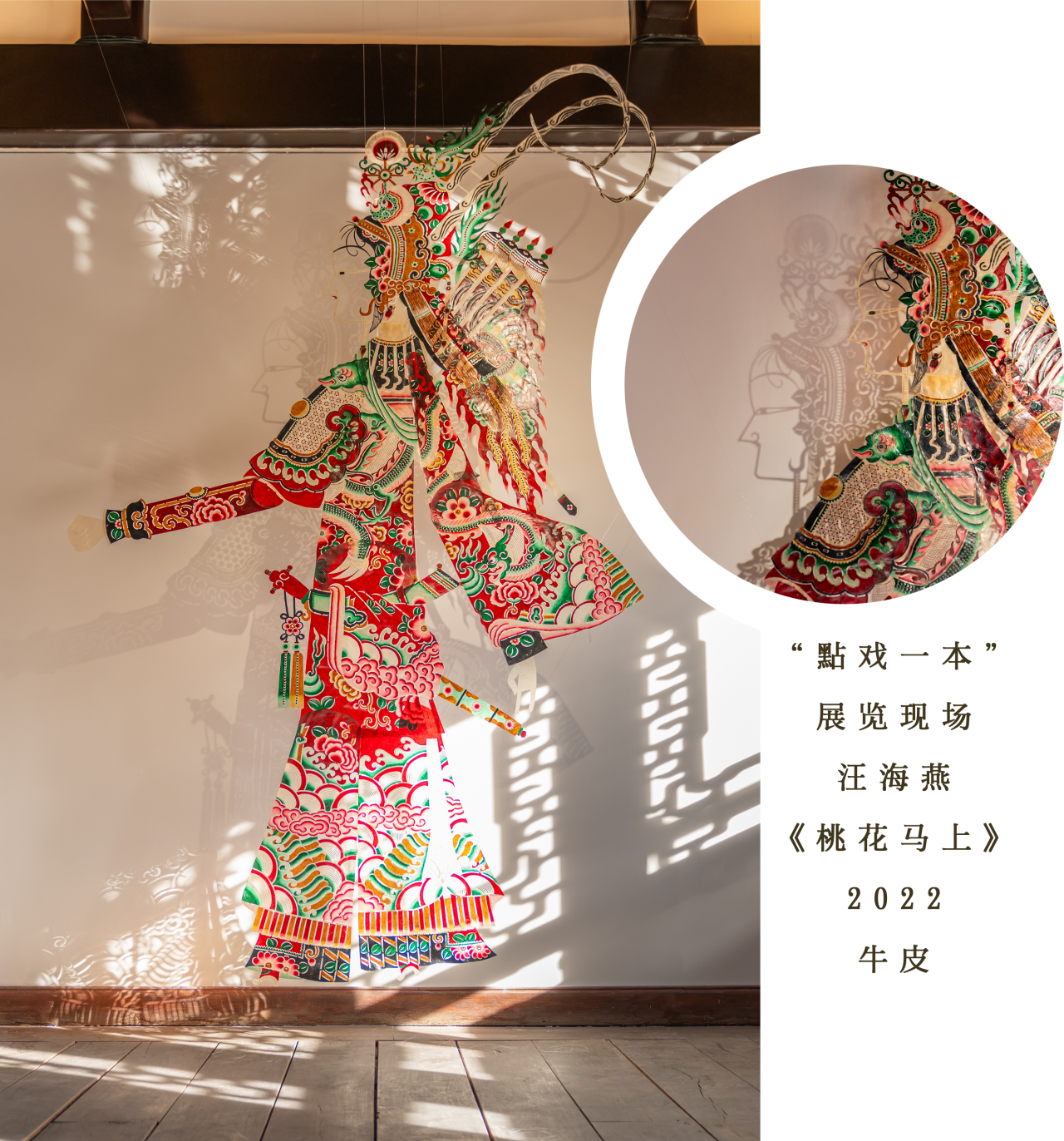
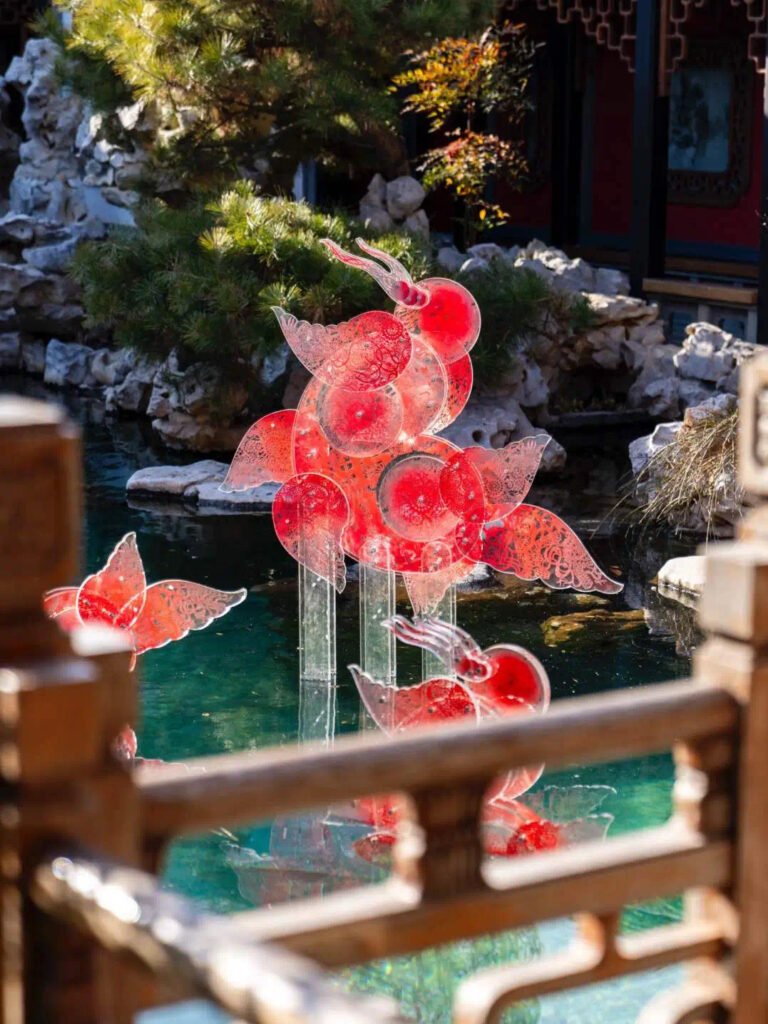
《桃花马上》汪海燕
《转音千手》是一组以三层垂直转经筒为载体的动力交互雕塑。艺术家鲁艺冉从敦煌壁画中提取数种手势将其立体化贴与金箔,铸成一只只金手,错落嵌于简身。简表以矿物颜料多层罩染技法再现敦煌壁画剥落质感,飞天衣袂流转轨迹暗藏三兔共耳数学拓扑。每层内置不同共鸣材质,观众随机拔动金手时皆触发不可复现的声序组合,形成“人一音,千转干声”的独特体验。
Zhuanyin Qianshou “is a set of dynamic interactive sculptures with three layers of vertical prayer tubes as the carrier. Artist Lu Yiran extracted several gestures from Dunhuang murals and applied them in three dimensions onto gold foil, casting them into golden hands that were intricately embedded in the barrel.
The cylinder table uses the technique of multilayer mineral pigment overlay to reproduce the peeling texture of Dunhuang murals, and the flowing trajectory of the flying clothes hides the mathematical topology of the three rabbits sharing the same ear. Each layer is equipped with different resonant materials, and when the audience randomly flips the golden hand, it triggers an irreproducible sound sequence combination, forming a unique experience of “one person, one sound, a thousand turns and a thousand sounds”.
《面壁》宋墨
该展厅中的石像墙是艺术家宋墨的作品《面壁》。佛像通常面对信众,背对后墙,代表觉悟他人、宽容万象。
而在宋墨的创作中,佛像转向墙壁,以背示人,意在引发观者对内心世界的重新审视。宋墨以国画大写意的手法,寻觅与佛像形态相似的鹅卵石,并通过融合鹅卵石的自然形态、体块与线面的元素,使其发挥自然的力量。
The stone statue wall in this exhibition hall is the work “Face Wall” by artist Song Mo. Buddha statues usually face believers with their backs to the back wall, representing enlightenment towards others and tolerance towards all things.
In Song Mo’s works, the Buddha statue turns towards the wall to show its back to the viewer, intending to provoke a re examination of the inner world. Song Mo used the technique of freehand brushwork in traditional Chinese painting to search for pebbles that resemble the shape of Buddha statues, and by integrating the natural form, blocks, and elements of lines and surfaces of pebbles, they were able to exert their natural power.
《九重天》邬建安
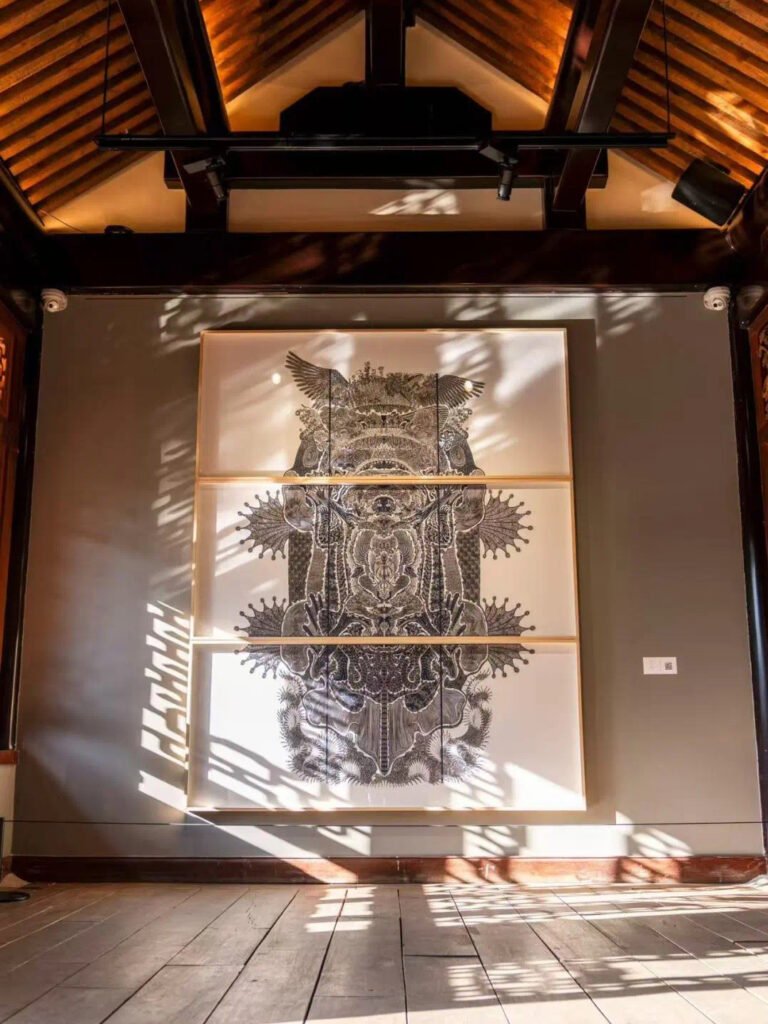
该展厅中的作品是现任中央美术学院实验艺术学院副院长邬建安的《九重天》。邬建安善于以当代的观念对经典的文学、宗教和哲学文本进行重新解读,建立其与个体精神世界的联系,发掘其中潜藏的有关当代社会和文化现实的母题。
该作品灵感来自于中国神话中的九重天概念,鸟乌、人面鸟、人头鸟、羽人、人、老虎、青蛙、娃娃鱼和鱼九种动物依次展开,他们象征着来自空间纵向维度不同层级,叠加、交错、吞噬、互相包裹融合。艺术家巧妙融合民间技艺,以皮影和剪纸演绎志怪神话故事。当光线穿透层层深浅不一的镂空纸面时,动物的光影形态在空间中延展。每一层动物的轮廓既清晰分明,又相互交融,生动诠释了中国传统自然观与宇宙观的哲学意蕴。
Nine Heavens is a work by Wu Jian’an, Vice Dean of the Experimental Art College at the Central Academy of Fine Arts. Renowned for reinterpreting classical literary, religious, and philosophical texts through a contemporary lens, Wu explores the individual’s spiritual world while addressing cultural and societal realities.
Inspired by the Nine Heavens in Chinese mythology, the piece features nine sequential creatures: a bird, a bird with a human face, a human-headed bird, a winged human, a human, a tiger, a frog, a Chinese giant salamander, and a fish. These beings represent vertical layers of space, overlapping, devouring, and enveloping one another. As light filters through intricately hollowed paper layers, their shadows animate the space. Each contour is distinct yet interwoven, reflecting traditional Chinese cosmology and our deep-rooted connection with nature.
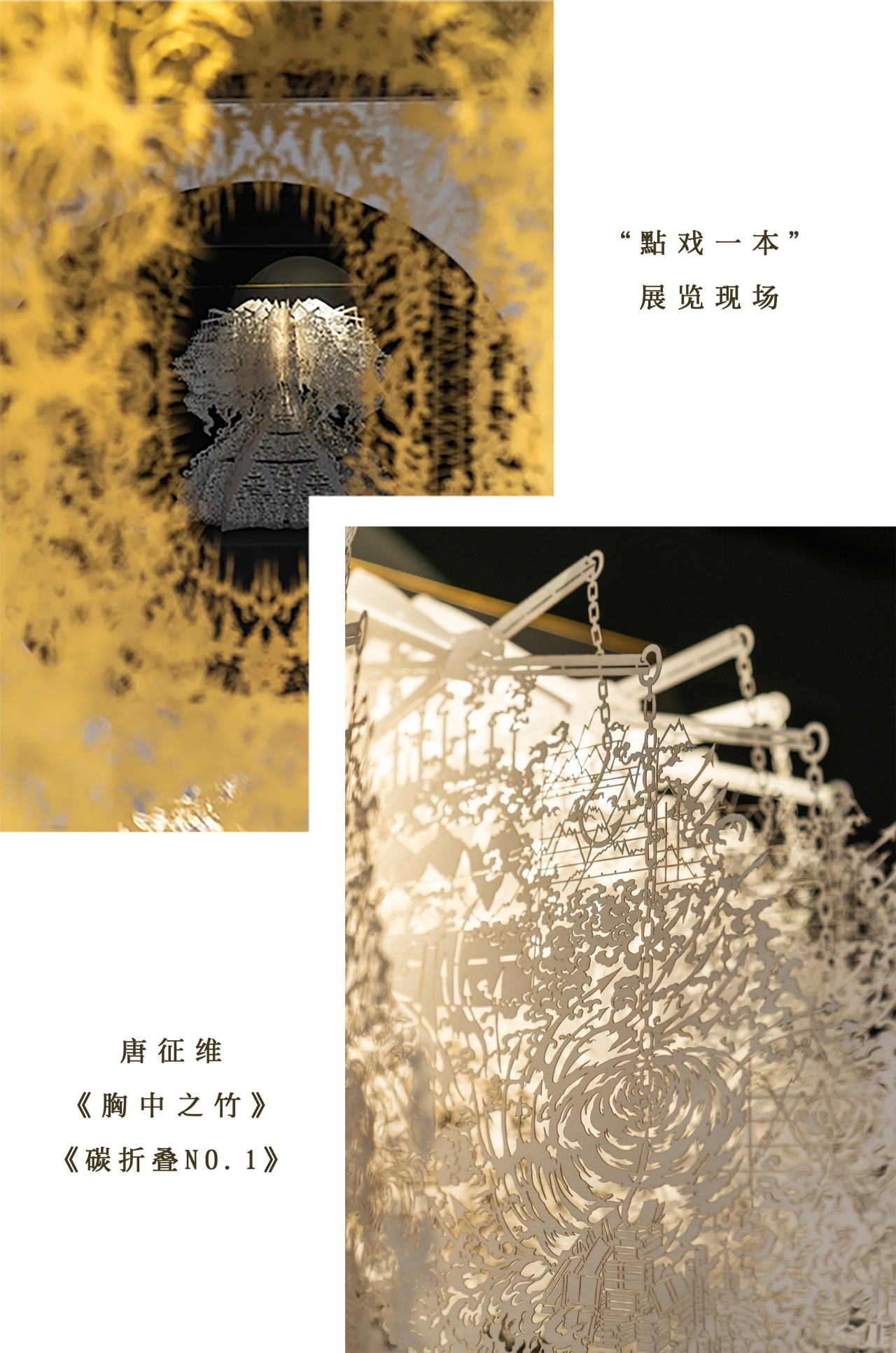
《胸中之竹》唐征维
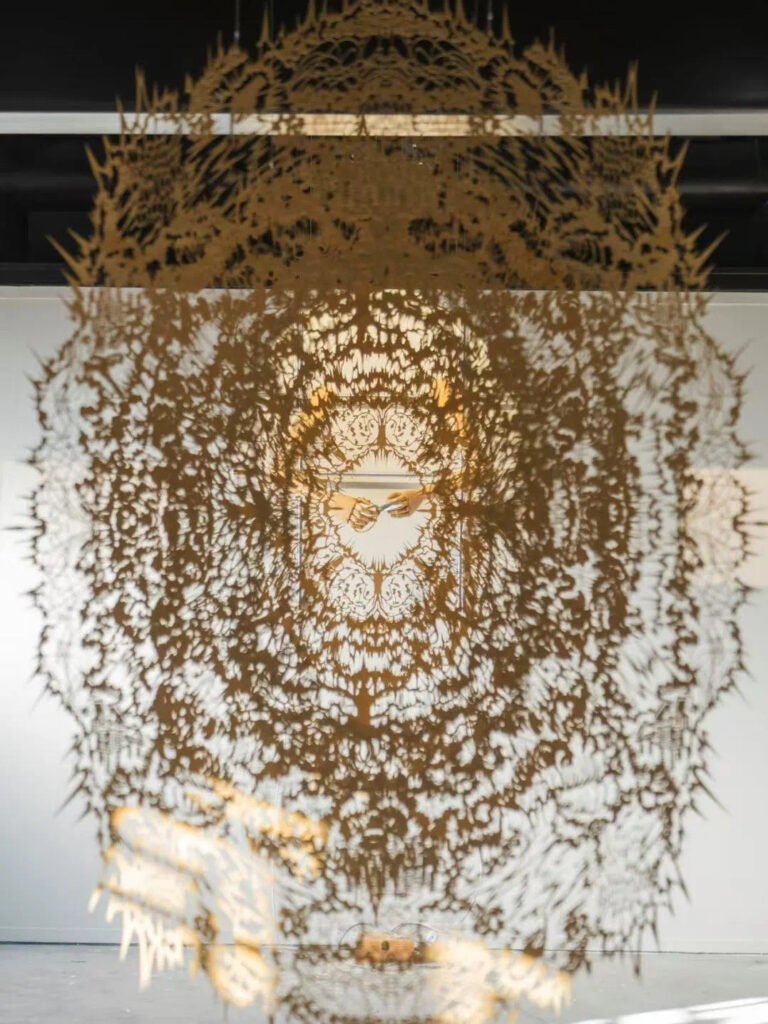
唐征维的作品《胸中之竹》是一件由木雕机械臂完成重复剪纸动作的动态装置。艺术家通过纸条被剪下、飘落的简单动态,提炼并还原了剪纸艺术中最纯粹的语言。
作品的前部分展现了构思过程的视觉物象,分为五个层次,逐步递进。纸条在波动感应的形式中扩散,转化內充满能量的形态物质。最终,在最后一部分,这些元素被汇聚整合,形成一个精心构建、充满权衡与意图的“局”物象,展现出剪纸艺术的深邃意涵与张力。
Tang Zhengwei’s work Well Thought-Out Strategy is a dynamic installation in which a wooden sculpture is manipulated by a mechanical arm to repeatedly perform paper-cutting actions. Through the simple motion of paper strips being cut and falling, the artist distills and restores the purest language of paper-cutting art. The front part of the piece presents the visual imagery of the conceptual process, divided into five layers, progressing step by step. The paper strips diffuse in a wave-like pattern, transforming into a form filled with energy. Finally, in the last section, these elements converge and integrate, forming a carefully constructed “situation”—an object that conveys the profound meaning and tension inherent in the art of paper-cutting.
《影灯·对镜》李寒轩
当窗理云鬓,对镜帖花黄
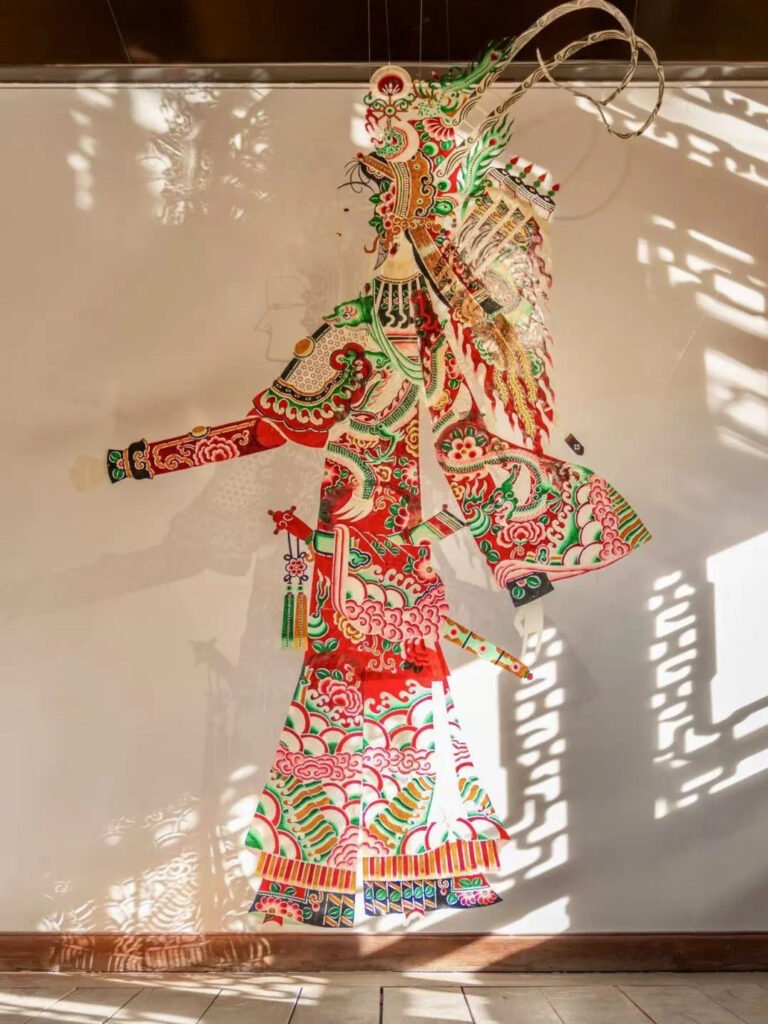
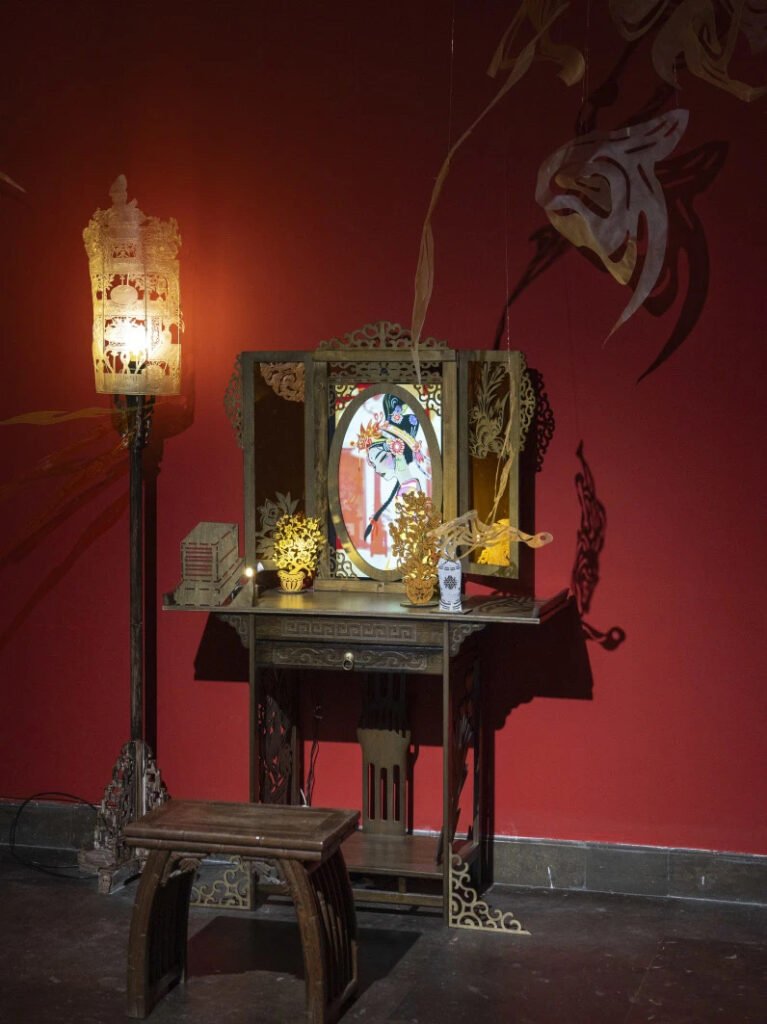
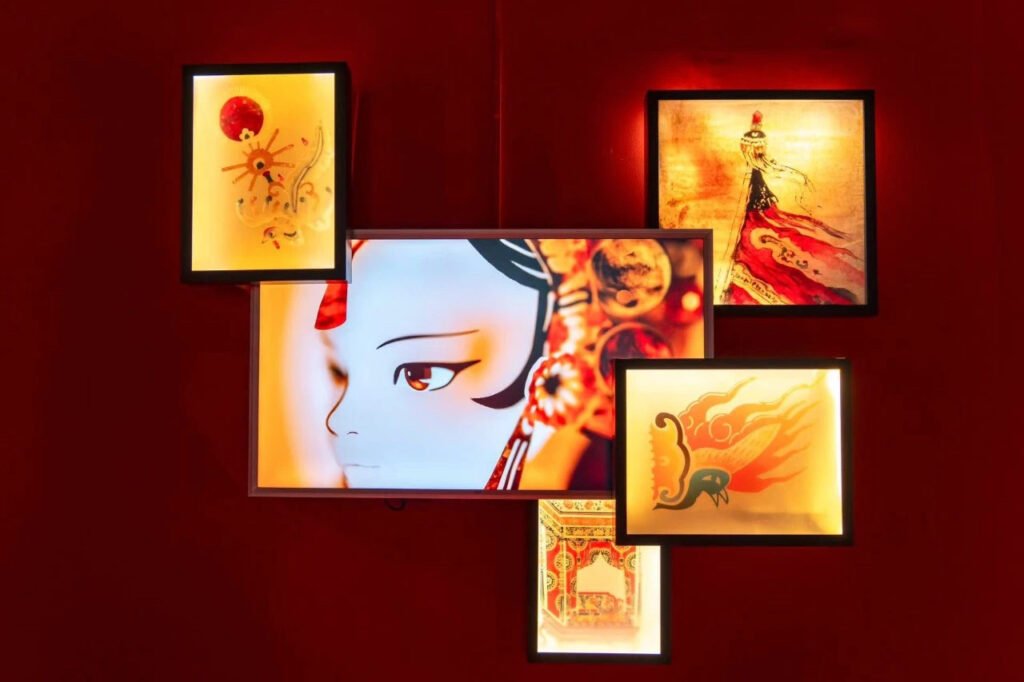
艺术家李寒轩的这件交互装置作品《影灯•对镜》融合了传统皮影艺术风格、实体布景与动作捕捉技术。以经典皮影戏《穆桂英挂帅》为叙事舞台,将现实皮影与虚拟数字妙趣交融,打造出一个戎装披挂前、只属于少女的英雄梦空间。屏风上,隐约可见少女穆桂英或者观众本人正在室内梳妆,撩开屏风纱幕,进得室内,镜前端坐,长臂舒展,则进入一个升维的皮影世界。作品中的皮影工艺品由汪氏皮影团队制作,数字交互则通过艺术家团队研发的AIGC工具生成,呈现出年轻艺术家以科技赋予传统新生的热盼表达。
In the adjacent gallery, we present the work Shadow Lamp: In Front of the Mirror by artist Li Hanxuan. She stands by windows doing her long hair and faces mirrors painting her brows fair.
This interactive installation merges traditional shadow puppetry art styles, physical sets, and motion capture technology. Using the classic shadow play Mu Guiying Takes Command as its narrative stage, it blends real shadow puppetry with virtual digital elements to create a heroic dream space, one that belongs solely to the young girl before she dons her military armor. On the screen, one can blurry see the young Mu Guiying, grooming herself indoors. By lifting the screen’s fabric, entering the room, and sitting before a mirror, stretching the arms, the viewer can be led into a higher dimensional shadow puppet world. The shadow puppets in the work were crafted by the Wang’s shadow puppetry team, while the digital interaction was generated using AIGC tools developed by the artist’s team, showcasing the young artist’s hope of promoting tradition through technology.
《当窗》党飞华《流光》王宁
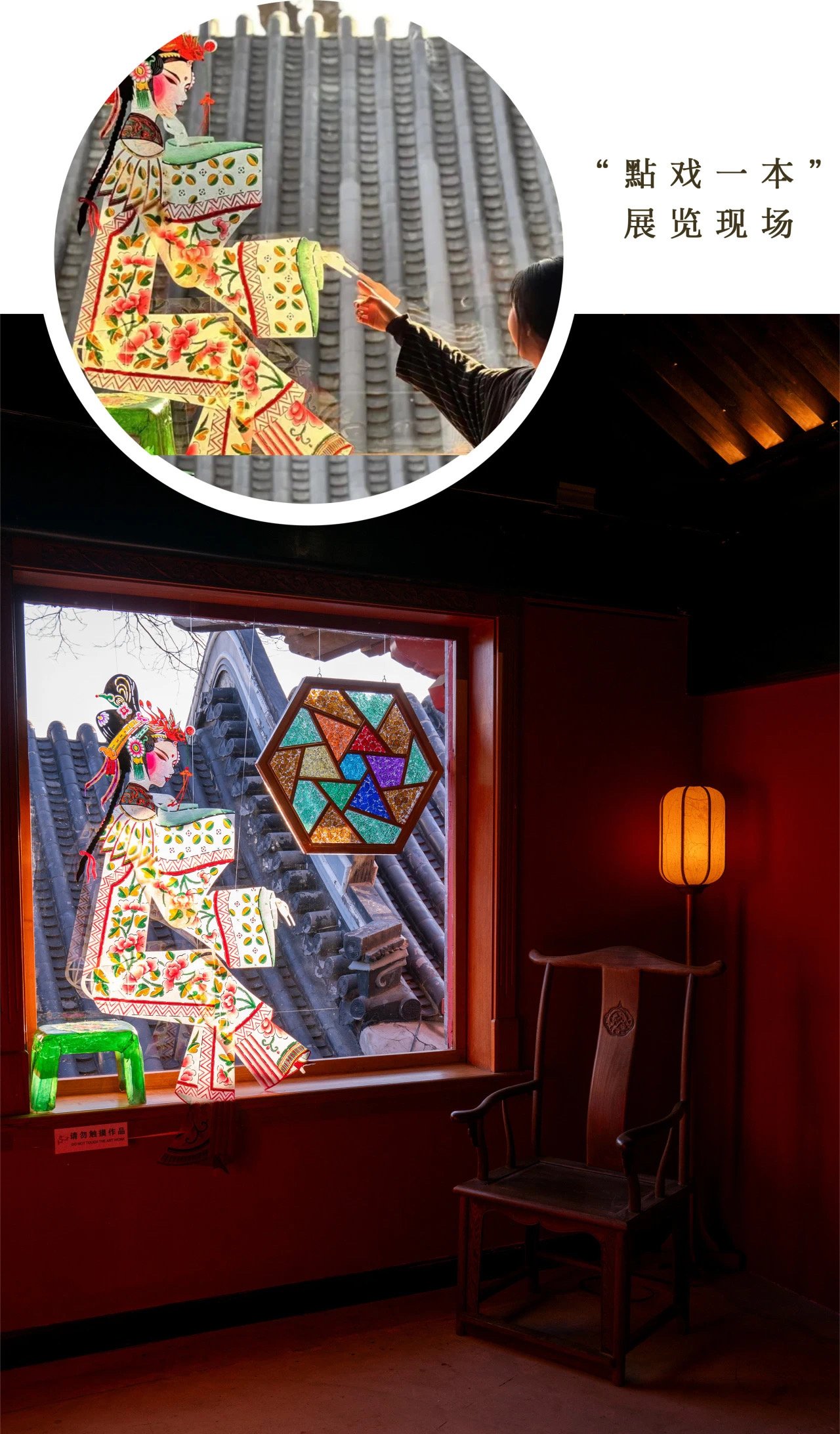
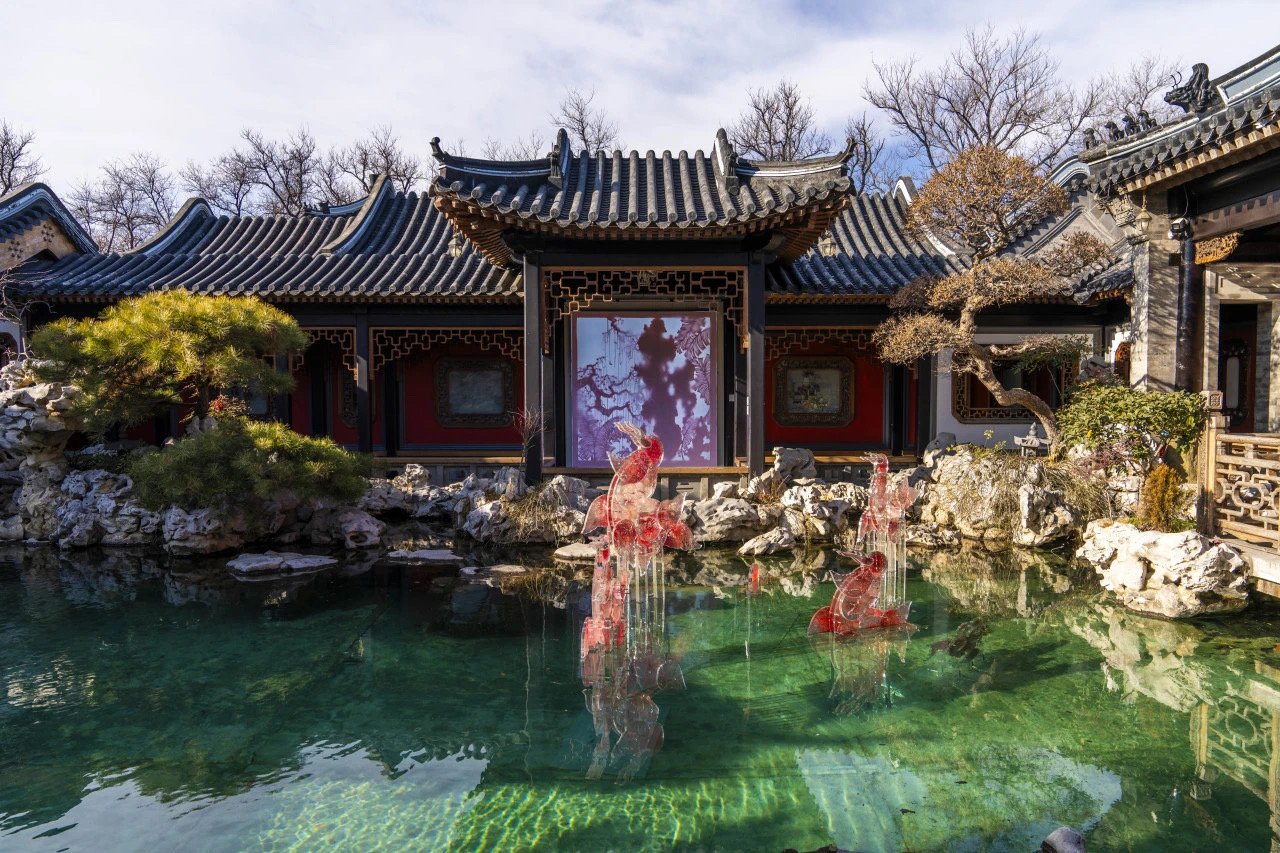
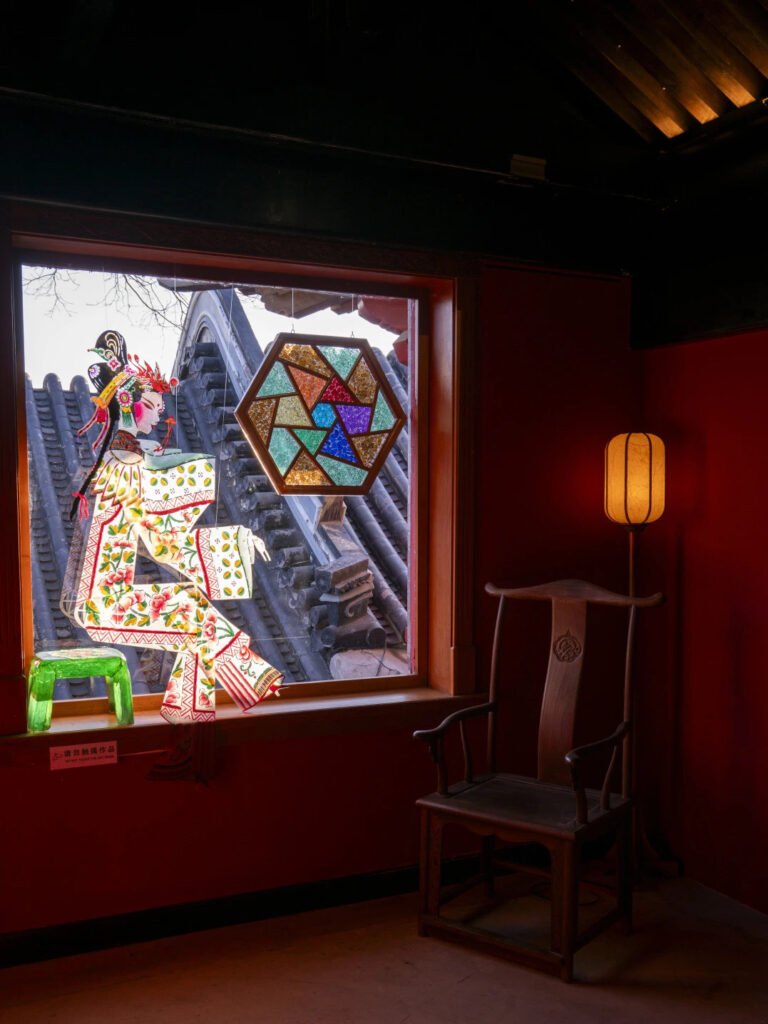
在中国传统建筑中,窗户不仅是通风采光的装置,更是重要的美学元素——一窗一画一世界。南池子美术馆二层展厅,首先映入眼帘的是党飞华的皮影装置作品《当窗》。作品中的穆桂英坐于翠绿色皮影板凳之上,卸下戎装,婀娜多姿、五官秀美,透过窗户与外部实景交相辉映,充满灵动与趣味。
穆桂英身后的六角花窗是王宁的作品《流光》。她借鉴传统园林中的景窗概念,以现代艺术手法融合色彩与几何结构,创作出极具视觉冲击力的花窗装置。作品以稳定的六边形为框架,内部由大小不一的三角形与菱形组成,营造出层次分明的几何空间。
材料上,《流光》采用碎片状透光玻璃,既再现中式园林中“移步异景”的视觉体验,也象征自然光影在花窗中的流动与变幻。观者可透过作品感受到传统园林的诗意与宁静,同时也体会到现代艺术带来的抽象美感与情感共鸣。作品不仅是对园林美学的致敬,更深入探讨了空间、光影与色彩之间的和谐关系,试图在传统与现代之间建立平衡。
整体视觉呈现出光影流动的意境,暗喻园林漏窗之美——既是光影交汇之处,也是人与自然互动的媒介。在色彩与工艺的重构中,静态材料被赋予了动态生命,象征着时光流转中传统与当代的深度对话。
Now, please follow me to the second-floor exhibition area. In traditional Chinese architecture, windows are important aesthetic elements—each one like a painting that opens to a world.
The first work you’ll encounter is At the Window by artist Dang Feihua. The shadow puppet of Mu Guiying, gracefully adjusting her hair, depicts the legendary heroine after shedding her armor. She sits elegantly on a jade-green bench, her delicate features and poised figure harmonizing with the real scenery outside, creating a poetic interplay between artwork and space.
Beside her is a colorful hexagonal window artwork titled Flowing Light, created by young artist Wang Ning from the Central Academy of Fine Arts. Inspired by classical garden windows, the piece blends traditional aesthetics with modern geometric abstraction. A stable hexagonal frame houses a mosaic of triangles and diamonds, forming a richly layered structure.
Made of fragmented translucent glass, the piece captures the shifting views and light effects found in traditional gardens. It reflects both the poetic stillness of nature and the emotional depth of contemporary abstraction. The window metaphorically evokes louchuang—the garden’s “leak windows”—spaces where light, shadow, and human presence intersect.
Through its dynamic color and form, the work breathes life into still materials, symbolizing an ongoing dialogue between tradition and modernity over time.
《影照集·象意》姚智皓
《转音千手》是一组以三层垂直转经筒为载体的动力交互雕塑。艺术家鲁艺冉从敦煌壁画中提取数种手势将其立体化贴与金箔,铸成一只只金手,错落嵌于简身。简表以矿物颜料多层罩染技法再现敦煌壁画剥落质感,飞天衣袂流转轨迹暗藏三兔共耳数学拓扑。每层内置不同共鸣材质,观众随机拔动金手时皆触发不可复现的声序组合,形成“人一音,千转干声”的独特体验。
Zhuanyin Qianshou “is a set of dynamic interactive sculptures with three layers of vertical prayer tubes as the carrier. Artist Lu Yiran extracted several gestures from Dunhuang murals and applied them in three dimensions onto gold foil, casting them into golden hands that were intricately embedded in the barrel.
The cylinder table uses the technique of multilayer mineral pigment overlay to reproduce the peeling texture of Dunhuang murals, and the flowing trajectory of the flying clothes hides the mathematical topology of the three rabbits sharing the same ear. Each layer is equipped with different resonant materials, and when the audience randomly flips the golden hand, it triggers an irreproducible sound sequence combination, forming a unique experience of “one person, one sound, a thousand turns and a thousand sounds”.
《阿墙》陈粉丸
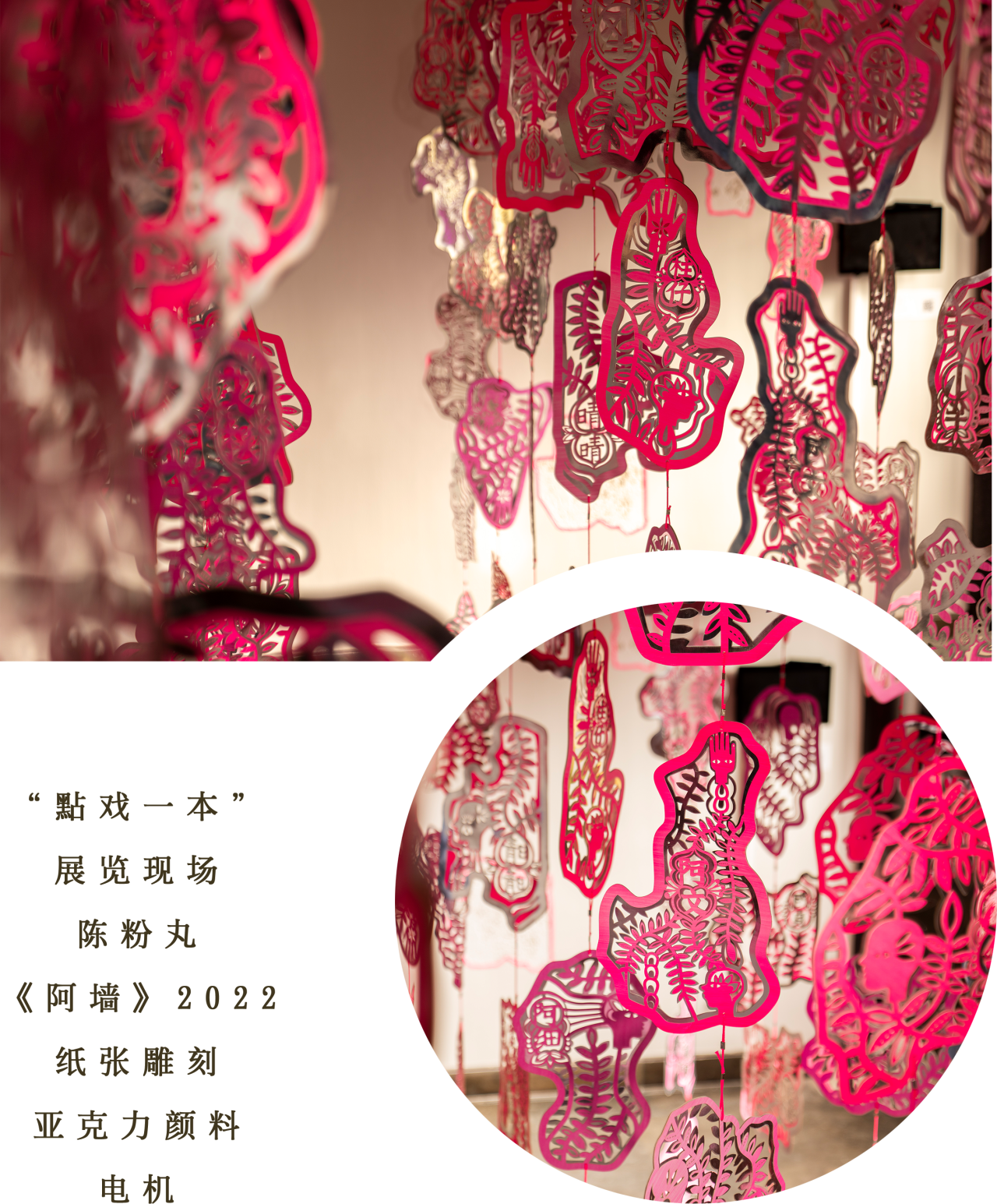
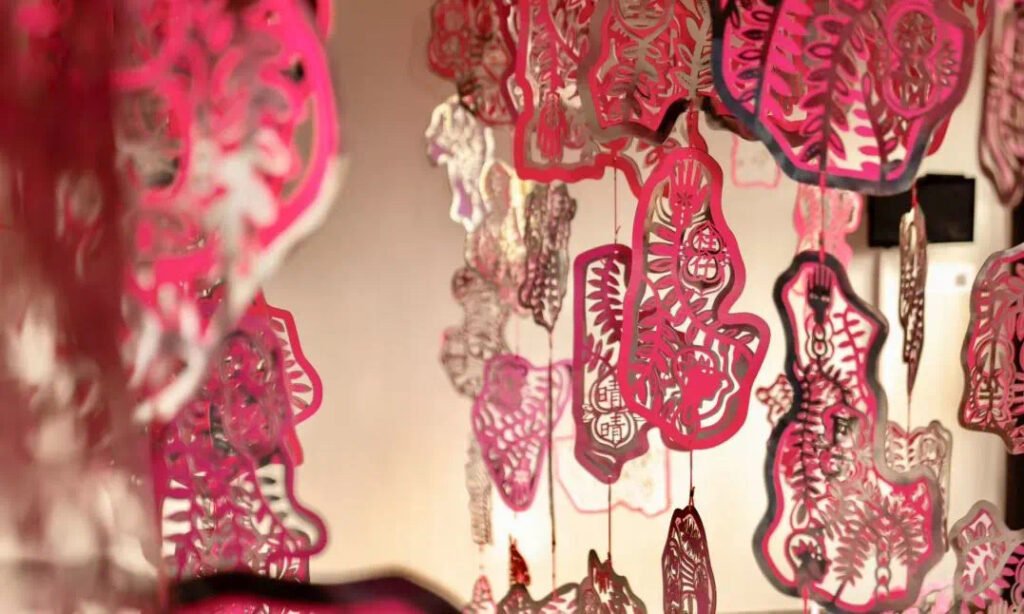
建筑承载了地域文化的历史及记忆,展览串联的最后一件作品《阿墙》是艺术家陈粉丸以太平墟的现状及在地性出发,结合其剪纸的创作手段,将镂空与勾勒的行为在南海西樵镇的太平墟上演。太平墟的建筑留下的痕迹,是时间在事物上做的“镂刻”,它似某个时刻历史推进的那一刀。艺术家通过观察和收集太平墟建筑外墙皮剥落的痕迹,对应老房子与曾经居民的名字,将这些痕迹取名编号,以纸张雕刻的形式提取临摹。
最终,这些纸张与新生结构将通过有序排列置于太平墟39-40号空间之中,创造出一个在地性历史时刻的集合,通过机械运动方式,这些记忆的碎片在空间中不停运转,闪烁重叠。此次在北京南池子美术馆,我们将《阿墙》方案重新呈现,并加入若干剥落的墙皮轮廓剪纸。
Architecture carries the memory of regional culture. The final piece in the exhibition, A Wall by artist Chen Fenwan, is rooted in the present-day context of Taipingxu in Xiqiao Town, South Sea. Using paper-cutting techniques such as hollowing and outlining, the artist brings to life traces left on Taipingxu’s old buildings—marks that resemble carvings made by time, frozen at a specific historical moment.
Chen collected the patterns formed by peeling walls and linked them to the names of past residents. These fragments were named, numbered, and meticulously reproduced through paper carving. In the original presentation, the paper-cut pieces were arranged alongside newly built structures in Taipingxu’s Spaces No.39–40, collectively embodying a local moment in history. As the installation moves mechanically, memory fragments rotate and overlap, evoking the passage of time.
For this exhibition at the Beijing Nanchizi Museum, A Wall is reimagined with additional paper outlines of weathered surfaces, expanding the dialogue between memory, material, and place.
《逐日》鲁艺冉
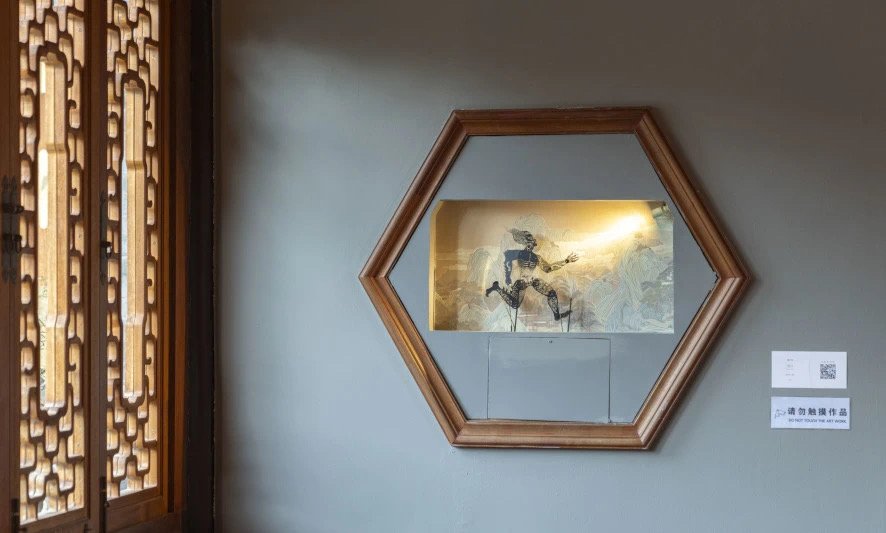
北侧窗户是鲁艺冉的皮影作品《逐日》。夸父逐日是国人都耳熟能详的神话故事。一个勇敢的巨人为了阻挡炙烤大地的太阳而拼命追逐。艺术家以夸父形象做影,在昏黄的灯光下,皮影人物在幕布上跳跃奔跑,跋山涉水。动态的皮影艺术,使一个有血有肉、有情感、有活力的勇士呈现在我们眼前,夸父坚定而充满力量的形象更加鲜活。
The northern window features Chasing the Sun, a shadow puppetry piece by Lu Yiran. Kua Fu Chases the Sun is a myth familiar to every Chinese: a brave giant relentlessly pursues the scorching sun to protect the earth. The artist uses the figure of Kua Fu as the shadow puppet, bringing him to life on the screen as he leaps, runs, and traverses mountains and rivers under the amber light. The dynamic shadow puppetry vividly presents a warrior of flesh, blood, emotion, and vitality, making Kua Fu’s determined and powerful image more compelling.
《大闹天宫》汪天稳
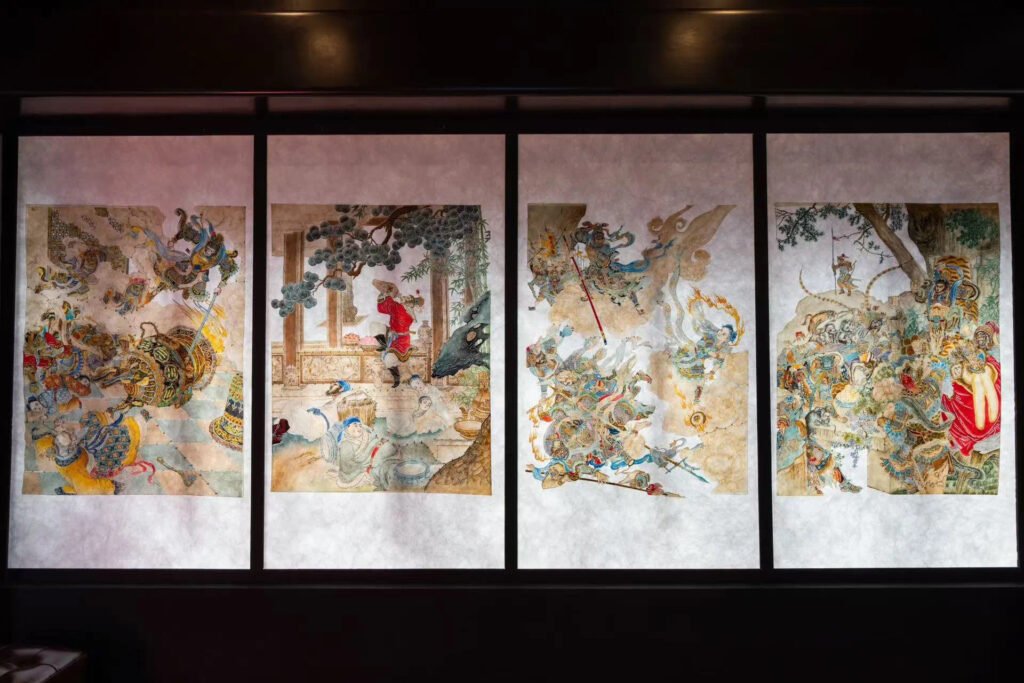
皮影作品《大闹天宫》是汪氏皮影第三代传承人汪天稳将皮影技法与中国传统工笔画艺术巧妙结合的创作。艺术家选取了《西游记》中孙悟空大闹天空的经典情节,以工笔画的设定进行形象设定与构图,借用皮影技法进行表现,在展示了工笔面独有的细腻效果的同时,通透灵动的皮影也为作品整体带来更多动态的光影魅力,光线透过艺术家雕刻的每一处细致的线条,不同颜色映照出不同的形状,天宫的富丽堂皇、花果山的热闹非凡连同故事情节的激烈与紧张,都在光影与精妙刻画的配合中展示出灵动的气质与充盈的生命力。
The shadow puppetry piece The Havoc in Heaven is a creation by Wang Tianwen, the third-generation inheritor of the Wang’s shadow, who smartly combines shadow puppetry with traditional Chinese meticulous painting techniques. The artist selected the classic scene from Journey to the West, where Sun Wukong causes chaos in the heavens, and used the delicate techniques of meticulous painting for character design and composition. Employing shadow puppetry techniques, the artist brought dynamic light and shadow effects to the piece. The grandeur of the Heavenly Palace, the bustling Flower-Fruit Mountain, and the intense, dramatic storyline are all brought to life through the interplay of light, shadow, and intricate details, showcasing a vibrant spirit and overflowing vitality.
《影动》党飞华
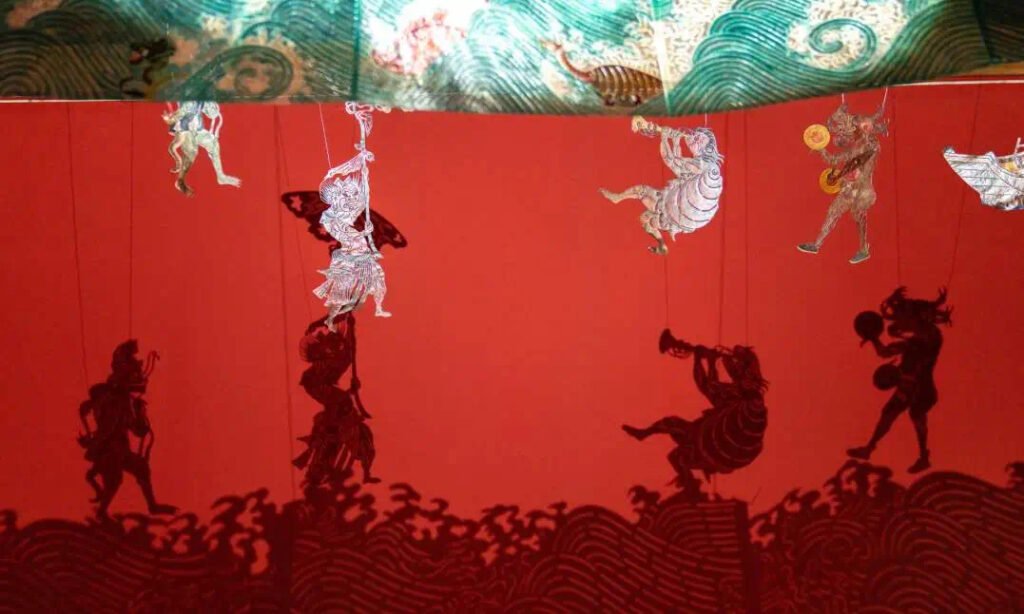
眼前是汪氏皮影第五代传承人党飞华的作品《影动》。作品以中国经典神话故事《白蛇传》中“水漫金山”的情节为灵感,通过两面墙上的光影投射,生动再现了虾兵蟹将助战的场景,用光影刻画了数个各具特色的神怪角色。皮影投射出的影子在墙面上变幻多姿,人物形象栩栩如生,带领观众穿越时空,身临其境地体验神话传奇。
In front of us is the work Shadow Movement by Dang Feihua, the fifth-generation inheritor of the Wang s shadow puppetry. Inspired by the classic Chinese mythological story The Legend of the White Snake and its scene of “The Flooding of Jinshan Temple,” the piece vividly recreates the battle scene with shrimp soldiers and crab generals, using light and shadow projections on two walls. The shadows cast by the shadow puppets transform and shift on the wall, with each character taking on distinct and lifelike features. This immersive experience allows the audience to travel through time and space to feel the mythical legend.
《影子的影子》宋墨
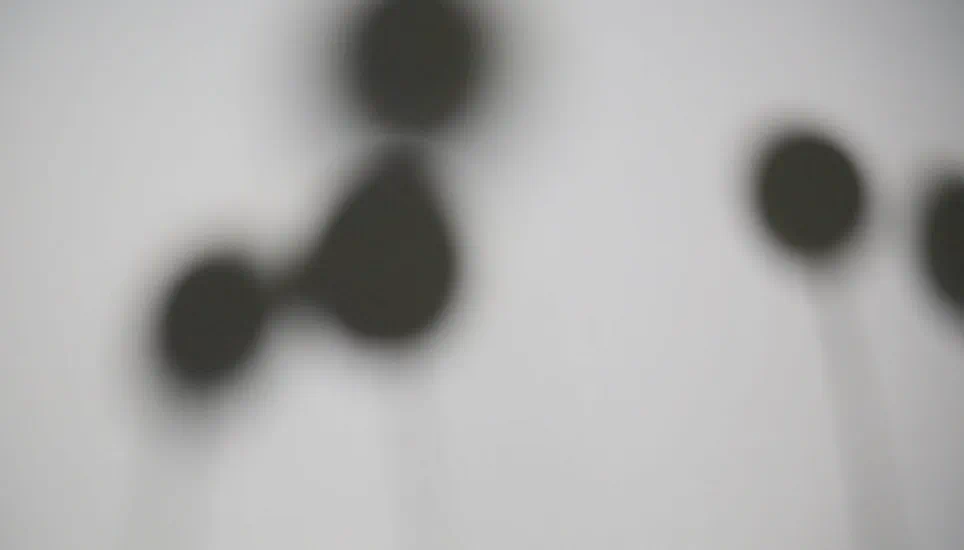
南侧窗户是艺术家宋墨的影像作品《影子的影子》,影子是这件作品的核心意象,我们能看到圆球的影子由一变多再由多变一,从单一的存在逐渐演变为多重的形态,再从繁杂的多个回归到最初的元一。碰撞、牵扯、粘连、缠绕,影子的影子在互动中诞生,又在互动中回返。艺术家用影子的复制与动态的交融,从视觉引导观众走向对存在的思考与阐释。
The southern window showcases The Shadow of Shadows, a video artwork by Song Mo. The shadow is the core motif of this work. We see the shadow of a sphere morphing from one to many and back to one again. This transformation reflects an evolution from a singular presence to multiple forms and then a return to the original unity. Through collisions, entanglements, adhesion, and intertwining, The Shadow of Shadows emerges in interaction and dissolves back into it. The artist’s continuous observation of shadows and the ever-changing manipulation of perspective provoke the audience to reflect on the concept of “existence.”
展览现场